Celebrating Faithfulness in a Throwaway World

Have you joined the Green Movement? As you well know, there is a concerted effort underway to reduce, reuse, and recycle. We are trying to be better stewards of the planet.

But we still live in a throwaway world. Too lazy to throw glass in the recycle bin? Throw it away. Something needs a minor repair? Get rid of it. Don’t like your car? Get a new one.

Then there was this guy named Joe. He drove his Honda one million miles. That’s right: one with six zeros behind it.

Honda heard about Joe’s faithfulness to their product. So they decided to celebrate Joe’s steadfastness. Here’s what they did:

What Honda did cost them very little in terms of their overall budget. Not only is Joe a fan for life, almost 100,000 people have viewed the YouTube video that you just saw. Many are probably marveling that a Honda could go for a million miles. Some are probably even considering purchasing a Honda as their next vehicle.

Have you notice faithfulness in an employee, co-worker, teacher, pastor, or friend?  Have you seen someone invest their time in people rather than just throwing them away, as it were? Is there a person you know who exhibits and demonstrates commitment above and beyond the call of duty?

Give her new car. OK…maybe you can’t afford that.

  • Throw him a parade
  • Toss some confetti
  • Buy a small gift
  • Make it public
  • Celebrate her in front of a festive gathering
  • Provide some kind of respite
  • Send flowers
  • Bring a bouquet of balloons
  • Create a fuss
  • Send a note
  • Get 25 people to stop by throughout the day and offer a word of thanks
Can you suggest a way to say thank you to your million mile hero?

One Simple Way to Be Just a Bit More Kind

Recently I have been thinking a great deal of the phrase: “Be kind; everyone you meet is fighting a hard battle.” Apparently the phrase is sometimes attributed to Plato, although that is disputed. No matter. Whomever said it, the phrase carries the gravitas of truth.

I’ve been noticing the looks of concern that follow smiles. I’ve seen the blank stares in meetings. I’ve observed the contemplative postures.

Some battles are known to me. Others I can only imagine.

But there’s one simple way anyone can deliver more kindness. It happens when we are aware of the way people treat us in the midst of our own battles.

Some have empathized and understood. I want to imitate them in my dealings with others.

Some have run rough-shod, completely unaware of the battles I fight. I don’t want to imitate that kind of treatment.

Self-awareness fosters empathy for others. 

The One who is kindest of all fought His own, epic battle. He fought it for you. Even when others don’t understand or treat you in the way you ought to be treated, He understands. He treats you with forgiveness, kindness, and compassion.

“Be kind and compassionate to one another, forgiving each other, just as in Christ God forgave you” (Ephesians 4:32). Or, to put it another way, “Be kind; everyone you meet is fighting a hard battle.” But, in Christ, the victory has been won.

Who needs your kindness today?

The Eternal Promise of Fall

For some reason, many people view the season of fall as a season of comfort. People love to get their hooded sweatshirts out of the drawer, pull on their sweat pants, smell the scent of burning leaves, and drink pumpkin spice lattes. Have you raked your leaves yet? Here in Milwaukee, Saturday was the perfect day to do just that. I wore a comfortable pair of shorts and a long-sleeved t-shirt.

You can find comfort in any season by trusting in two incredible promises of God. Moses is 120-years-old, and about to turn over leadership of Israel to Joshua. In the late fall of his life, he addresses all of Israel. It is his desire to provide comfort and promise for the people of Israel as they are about to enter the promised land. “Be strong and courageous,” he says. “Do not be afraid or terrified because of (your enemies), for the Lord your God goes with you; he will never leave you nor forsake you” (Deuteronomy 31:6).

He will never leave you nor forsake you. Those sound like two “fall” promises to me.

  1. He will never “leaf” you. Leaves start their lives as minty green little sprouts bursting from a tree. They grow and flourish and live a lively and breezy life all summer. Then fall comes and their color changes. Their grip to the branch begins to loosen. Before you know it they’re hanging on by a thread. When they just can’t hold on any longer, they let go and float softly to the ground. When we, like leaves, are dead in our sin and fall to the ground, our heavenly Father gently cradles us in His hand and grafts us back into the Branch. It is when we are connected to the Branch that we receive the sap of life. We are forgiven, new, and renewed. He will never “leaf” you on the ground.
  2. He will never for- “rake” you. At our house we get to simply rake our leaves into the street, where the city comes by late at night, sweeps them away, and incinerates them. When we rake our leaves into the street we abandon them. We wash our hands of them. We are happy to see them taken away and burned. Because He loves us, God never rakes us away and abandons us. Instead, He abandoned His own Son. On the cross. Jesus cried, “My God, My God, why have you forsaken me?” Jesus was raked into the depths of hell so that those who trust in Him will never be. He is with us whether we know it or not, whether we like it or not, whether we believe it or not, whether we feel we need Him or not. He will never for- “rake” you.

Just before Jesus ascended into heaven He made a mandate that included a promise. He said, “Therefore go and make disciples of all nations, baptizing them in the name of the Father and of the Son and of the Holy Spirit, and teaching them to obey everything I have commanded you. And surely I am with you always, to the very end of the age” (Matthew 28:18-20). In making disciples by baptizing and teaching, Jesus is with us “to the very end of the age.”

Whether you are Moses or Joshua, Mary or Martha, a botanist or a gardener, God will never “leaf” you or for- “rake” you. He is with you always to the very end of the age, to provide forgiveness, life, and salvation.

What is it that reminds you of God’s presence in your life?

How to Stretch Yourself By Adopting 3 Attitudes

When was the last time you stretched yourself in a big, uncomfortable way? I recently did just that when I attended the Dynamic Communicators Workshop. It’s a workshop led by nationally renowned speakers, Ken Davis and Michael Hyatt. It was the hardest I’ve worked at a conference in a long, long time. It gave me the opportunity to bring clarity and focus to all of the different ways I communicate as a pastor.

We first learned a method of constructing all different types of communication called SCORRE™. SCORRE™ applies in most every kind of communication, especially pertaining to preaching and public speaking. In addition, SCORRE™ suggests a way of questioning oneself and determining the place to which you will be taking your audience. If you know where you want your audience to go it makes it that much easier to take them there.

Every day of the conference we worked with a personal coach who helped us craft and present a speech to a group of our peers.  We had to give three separate speeches to our small group. Each of us were critiqued, evaluated, and encouraged. I can’t imagine a more helpful conference for anyone who communicates for a living.

But it was a stretch. It’s not easy to emotionally open up in front of a group of strangers. But those strangers became friends. They provided constructive criticism. They lent support. They did so because they were in the same boat. We all stretched ourselves.

You can stretch yourself when you adopt three attitudes:

  1. Willingness. An attitude of willingness is essential. You can make excuses all day, every day that will keep you from stretching yourself and taking the next step. I had to be willing to get away from the demands of every day work life, willing to make a commitment to do something uncomfortable, willing to work hard. An attitude of willingness will stretch you simply by making the commitment to take the plunge.
  2. Vulnerability. An attitude of vulnerability is a dangerous thing. Studies have shown that one of the greatest fears people have is speaking in public. That’s probably because when we are in front of people we are exposed to all kinds of risks. What if they don’t like me? What if I forget my words? What if I look silly? But an attitude of willing vulnerability is actually an endearing thing to an audience. Open yourself up and you will be loved. An attitude of vulnerability will stretch you by enabling you to confront and overcome fears.
  3.  Creativity. An attitude of creativity means that you are willing to say, “yes” to paths, twists, turns, and trails no matter where they may lead. At the SCORRE™ Conference we had to come up with three different speeches. It stretched my creativity. I had to say, “yes” to doing each of the three speeches because they were expected of me. What a great exercise. Saying, “yes” forced me to explore topics and expand my creativity. An attitude of creativity will stretch you by helping you discover new and exciting paths in your work and even in your play.

What ideas do you have to help me stretch myself even more?

A Simple Way to Help Abused Orphans in Haiti

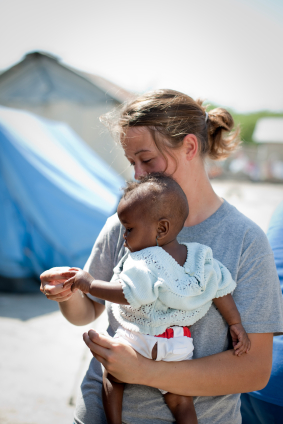
The world is getting smaller. There is just one degree of separation between me and the people of Haiti. For a number of years my wife’s uncle has been going to Haiti to direct a boy’s choir. He and his crew have had an incredible impact on those underprivileged children both before and after that country’s devastating earthquake.

The world is getting smaller. Through the power of social media I have learned of a tragic situation developing in Haiti. The director of an orphanage had been embezzling money, withholding food, and selling clothing meant for the children. He is now in jail. However, seventy-five children in the orphanage are still in great danger. Food has disappeared, children have been abused, and some have even disappeared. There is one five-year-old girl who currently weighs only eleven pounds.

You read that right. Eleven pounds.

The world is getting smaller. If you want to know more about this tragedy taking place outside of our borders, click here.

The world is getting smaller. An effort is being undertaken to raise awareness in the media regarding this disturbing situation. The group that discovered it is asking that a petition be signed that asks CNN to use its media voice to spread the word and help end child abuse and child trafficking. Again, to read more about it and for a link to the petition, click here.

The world is getting smaller. It means that you and I can have a very real, very positive impact on children desperately in need of rescue, care, and a new lease on life. Please consider signing the petition. Please consider making your voice heard. Please consider using the tools at hand, tools that make the world a smaller place, to bring hope into the life of a child in Haiti.

How can I help a cause that’s important to you?

How to Demonstrate Loyalty in a Fickle World

Loyalty is like common sense: it’s not so common anymore. It is a precious commodity. It is rarely seen and, thus, valued when and where it is found.

Athletes jump from team to team. Employees jump from job to job. People move from city to city. It’s hard anymore to find loyal fans, workers, or citizens.

It’s even becoming difficult to find Christians who are loyal to their church. In an age of consumerism, the church itself has become just another marketable product that people will quickly leave if they aren’t entertained or if they don’t have every one of their personal needs or preferences met.

And when churches or organizations try to be faithfully creative or inspiring, they meet resistance and threats. It’s so easy to pick up the marbles and go home….or to another church.

Today you have the chance to be loyal. Demonstrate your loyalty by:

  • Complimenting your boss or co-worker publicly;
  • Going the extra mile even when it’s unexpected;
  • Saying good things (about your job, organization, or church) to friends, family, and neighbors;
  • Encouraging others to be faithful and loyal;
  • Using every opportunity to vocally show support;
  • Surprising others with compliments, gifts, or concrete encouragement.

Your demonstration of loyalty will go a long way toward encouraging loyalty in others. Members of one of my former congregations demonstrated their loyalty one snowy Sunday when no one could get to church except those who walked. That morning we had eight loyal people in attendance for worship, all of whom trudged through the snow. Word spread, and their loyalty had a positive impact on others.

Thankfully, it’s only human beings who are fickle. The most loyal, dependable, trustworthy, devoted, reliable constant in life is God. He made sure to send His Son for us, who was loyal to the Father even to the point of death. Nothing or nobody could distract His perfect loyalty.

Please share an example of loyalty or another way loyalty can be demonstrated with a comment below.

How to Win Raving, Life-Long Fans

In case you haven’t noticed from my recent posts, tweets, and Facebook updates, I’m a Milwaukee Brewers fan. Don’t stop reading just yet, because this post really isn’t about that. It’s about fans in general.

Have you ever noticed how a winning team draws far more fans than a losing team? I’ve been noticing a great many more Brewers’ T-shirts, hats, and clothing around our fair city. I guess that’s evidence of what many long time fans would call “bandwagon fans.”

I’ve noticed a goodly number of family and friends who haven’t cared too much about the Milwaukee Brewers in recent years, let alone early this very summer. And yet it seems that they have become raving fans now that the team has seen success. I noticed it already in 2008, the last time the Brewers went to the playoffs. There seemed to be more evidence of fans late in that summer. Now that the team has made the League Championship Series, the evidence of fandom around the city is greater than ever.

Some long-time, dedicated fans resent fair-weather, bandwagon fans. I used to be that way, too. But I’m changing my mind about that. I’m noticing that the winning and excitement is an entree to true fandom. People who, in the past, only paid cursory attention to the sport, are now learning more, engaging more, and caring more. Many are going to be baseball fans for years to come.

There are lessons in all of this for churches*, non-profits, and small businesses:

  1. Create energy and excitement. A neighborhood event, article in the local newspaper, or creative energy around regular happenings draw attention and win “fair-weather fans.”
  2. Take advantage of the energy and excitement of newfound “fans.” No one has more energy in your organization than a new, raving fan. Use that energy to create even more attention and buzz.
  3. Take that growing energy and excitement to tired and worn out members and employees. Energy and excitement is contagious. When long time members and employees see a newfound  spark in others, it’s inspiration for their own renewal. Intentionally put newfound “fans” together with your long time “fans.”
  4. Cultivate sustained energy and excitement through creative use of well-planned events. Intentional forward planning and well-spaced events sustain both new and old “fans” for the long haul.
If you had one chance to create a raving “fan,” how would you do it?

*Please note: Only the Gospel of Jesus Christ changes hearts, makes Christians, and enables the sanctified life. However, there is certainly human choice in terms of choosing a local church or identifying with a specific congregation. Any human “success” is only the result of God’s grace and mercy to sinners.

How to Take a Message National

Did you know that September 29th is National Coffee Day? Neither did I…until this past September 29th. On that day this year there was no way around knowing it was National Coffee Day. Facebook status, after Twitter update, after email blast came across my screen. There were free cups of coffee offered, people buzzed on caffeine all day, and a greater awareness of local coffee shops all over the country.

National Ice Cream Day is July 18th. National Peanut Butter and Jelly Day is April 2nd. National Kiss Day is July 6th. National Best Friend Day is June 8th. National Corn Chip Day is January 29th.

I predict that you’ll become more and more aware of these “National” days every year. Media, screens, and messages are everywhere. Marketers are getting increasingly savvy about getting their messages out.

With the prevalence of social media, “National Days” are much more national now. I don’t even like coffee, and I was tempted to stop at a local Starbucks on September 29th. Repeated messages in many forms really do have an impact.

We live in a time where it is much easier to get a message out. But there is also much more clutter, distracting from a message. So when you have an important message, and the church has the most important Message on the planet, it’s essential to use every tool possible to broadcast it to the world.

When you want to get a message out, consider these things to clear the clutter:

  1. Repeat your message. Once isn’t enough. If you want your message heard and remembered, it must be repeated (some say at least seven times).
  2. Be creative in the use of media. Tie your message together throughout Facebook, Twitter, your web site, and email blasts.
  3. Make your message distinct. Give something away. Use intriguing art. Tell a story. Ask readers to take action. Do something surprising.

What message will you take national today?

7 Reasons Playoff Baseball is Perfect in Person

I have been a fan of the Milwaukee Brewers most of my life. I still vividly remember when they moved from Seattle to Milwaukee in 1970. I have stuck with them through thick and thin…mostly thin. The construction of Miller Park brought hope to the Milwaukee fan base. We thought it would generate the revenue to field a contender. When the construction was almost complete fans were invited to come and sign the last piece of the stadium that would be put into place high in the rafters. I signed my name and wrote: “World Series here we come.” But the years of futility continued.

I wasn’t able to go to the rare postseason games in 1982 or 2008. Instead, season after season I enviously watched fans of the Yankees, Red Sox, and others on postseason TV living and dying with their teams. I always wondered what it would be like to actually sit in the stands for the most meaningful games of a baseball season.

This past weekend I finally had the chance to attend a Brewers’ postseason game. What a game it was. The 4-1 Brewers win was one of the most incredible sporting events I have ever attended. Even a casual baseball fan would have loved the atmosphere. Since seven is the number of “perfection,” here are seven reasons why:

  1. Mood and Attitude. Already on the walk through the parking lot there was an electricity in the air that was far more evident than a regular season game. People were happy and amped up for meaningful baseball in Milwaukee.
  2. Bunting. Not the type where a hitter dribbles a batted ball in front of home plate…the red,white, and blue kind. You don’t see that kind of bunting in a regular season game. It signifies that something special is happening. Something is different.
  3. Fan Unity. Playoff baseball crowds are more unified than maybe any other segment of society. The home town fans are all cheering for the same team. Nobody cares who’s Republican or Democrat, Christian or Jewish, black, yellow, or white. A home run means high fives all the way around with perfect strangers.
  4. Educated Fans. When I attend regular season games I refuse to participate in “the wave.” It’s for amateur fans who aren’t paying attention to the game. Not once did anyone try to start the wave at the playoff game. Everyone was hanging on every pitch, too “busy” to start the silly wave.
  5. Championship Banners and Field Markings. The new banners and markings on the field meant that the goal of the 162 previous games has been met. There is no mistaking that it is the post-season.
  6. Importance of Every Pitch. The stakes are much higher. The strategy is amplified. Every hit, error, and throw could mean a change in momentum, a win, or a loss. It’s the ultimate “reality entertainment.”
  7. The Roar of the Crowd. The cheering is great at regular season games. But watch a baseball leave the park during the playoffs, and the roar is deafening.

Leaving Miller Park with a first-game win in a five-game series put a bounce in my step the rest of the weekend. There’s almost nothing like that kind of exhilaration…at least not for a baseball fan like me.

What’s been your most exhilarating experience at a public event?

Enhancing Collaboration with the S.T.O.P. Method

Apparently stop signs are optional in our neighborhood. I have had an increasing number of close calls with drivers who, at worst, refuse to comply to a stop sign, or, at best, simply tap the break.

Another favorite driving method of people in our neighborhood is the famous “alley honk.” One drives down an alley at a high rate of speed, approaches the sidewalk at the end, and, instead of slowing down, honks so that any potential pedestrians can fend for their lives by diving out of the way.

They think they own the road!

It got me to thinking that I am too often like those drivers. As I drive down the road of life, I sometimes charge forward, without slowing down, and without consideration for the thoughts, needs, or desires of those around me. Plato is supposed to have said, “Be kind, for everyone you meet is fighting a hard battle.” It doesn’t take much for me to make someone’s battle even more difficult by charging ahead without slowing down and being sensitive.

I think I own the road. But I share the road of life with all kinds of other travelers. Some go flying by me like they’re on the autobahn. Others pull in front of me and slow me down in the middle of my busy day. Still others are in the left-hand lane with their right turn signal on, happily oblivious to it all.

One of the keys to both creativity and effective ministry is collaboration. It’s difficult to move forward without others giving direction and providing protection. Consider the “stop” method of slowing down and avoiding the “alley honk”:

  1. S = Stop. Each morning stop and consider the people with whom you will interact throughout the day. Think about the challenges, struggles, and difficulties they may be going through. It will prepare you for the interactions you may be having. You can approach each encounter in a unique and caring way.
  2. T = Talk. Instead of a texting or email exchange, talk face to face as much as possible. Try to avoid the “alley honk,” where you just shout your position and keep on moving. Listen carefully to other thoughts and ideas. Come to agreement and move forward knowing that each member of the team is protecting the other.
  3. O = Observe. Instead of just plowing through the day, or a meeting, or an activity, take some time to observe body language of those with whom you are working, creating, or planning. Body language speaks volumes and may help you understand the climate of the room before moving ahead into work. Observe body language and move ahead accordingly.
  4. P = Proceed. Once you have stopped, talked, and observed, it’s time to move forward. Caution has been observed in the previous three steps. Now it’s time to take action. Work with your team, family, or colleagues to reach common goals and objectives. As long as you have consensus, move boldly.

It’s always a good thing to observe stop signs and proceed with caution. It’s just as important in life as it is on the road. Stop, Talk, Observe, and then Proceed. When done collaboratively these steps will result in creative and excellent work.

What steps would you add to the “S.T.O.P.” list?